How Emerging Technologies Like AI and Blockchain Are Transforming GIS Worldwide
Summary
From blockchain-based land registries to AI-powered spatial analysis, emerging technologies are reshaping the global GIS and geomatics industry.
Blockchain and GIS: transforming how the world records land
April 2026 · 5 min read
Geographic Information Systems (GIS) have long been the backbone of land administration — but a persistent problem has shadowed the technology for decades. Centralised databases are only as trustworthy as the institutions that manage them, leaving records vulnerable to manipulation, corruption and unauthorised changes.
Blockchain is emerging as a credible answer to that problem. The distributed ledger technology, best known for underpinning cryptocurrencies, is now being applied to geospatial data management — creating records that are tamper-proof, fully auditable and owned by no single party.
How it works
In a conventional GIS setup, land ownership records, survey boundaries and transaction histories are held in a single database controlled by a central authority. Errors — whether deliberate or accidental — are hard to detect and harder to prove.
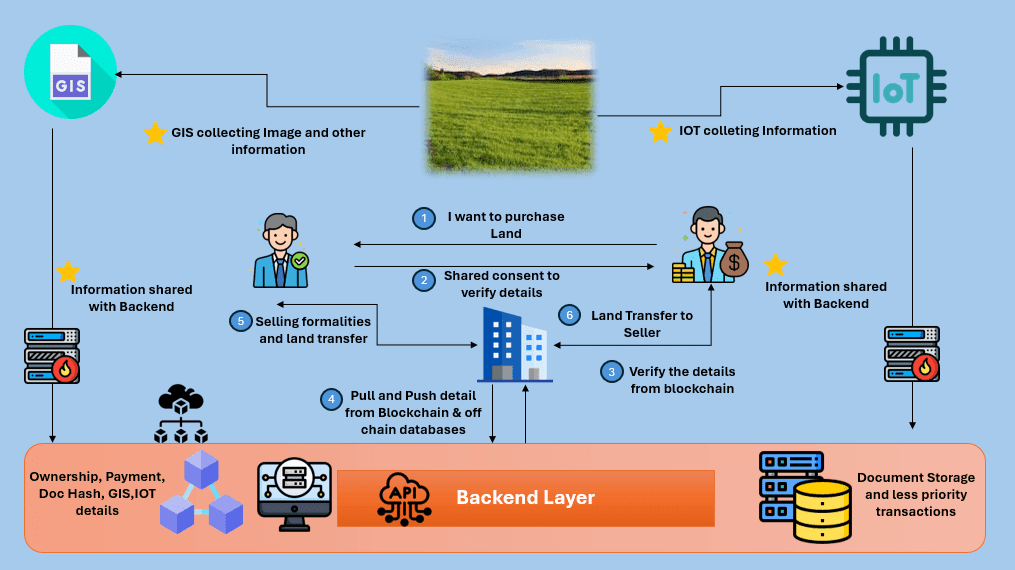
Blockchain changes that by distributing the same data across a network of nodes. Every update is cryptographically signed and time-stamped. Once a record is written, it cannot be changed without consensus from the entire network.
Once data is on the chain, altering it without network consensus is computationally impossible — that is the guarantee land administrators have been looking for.
Applied to GIS, this means spatial records are tamper-proof, transparent, decentralised and fully traceable over time — a significant upgrade over traditional systems.
Where it is already being used
Land registry systems
Sweden
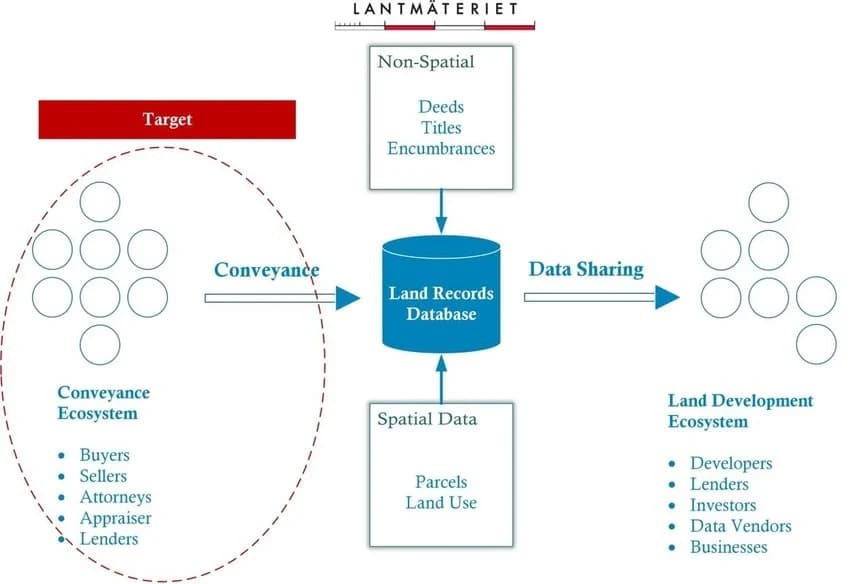
The Swedish mapping authority has been piloting a blockchain-based land transfer system, compressing a process that once took months into days — with a complete digital audit trail from offer to title deed.
Georgia
The Republic of Georgia formally registered land titles on a public blockchain through its National Agency of Public Registry, becoming one of the first countries to do so at scale.
Smart contracts in property transactions
Self-executing smart contracts can automate ownership transfer the moment a payment clears — triggering cadastral updates and filing stamp duty digitally, without weeks of solicitor correspondence.
Secure data sharing across agencies
Governments and infrastructure operators increasingly need to share geospatial data across departments without surrendering control over it. Blockchain provides a shared, audited view where every read and write is permanently logged.
Benefits and challenges
Benefits
Reduced document fraud and forgery
Faster property transactions
Lower administrative costs over time
Single source of truth across agencies
Challenges
High upfront infrastructure costs
Shortage of specialist expertise
Legal frameworks lag the technology
Scalability across national datasets
The road ahead
Blockchain will not replace GIS platforms — it will underpin them. Its greatest contribution is not speed or cost reduction, but trust: a verifiable, immutable foundation on which land rights, survey data and spatial agreements can rest without depending on the good faith of a single institution.
Early pilots suggest the technology is ready to move from experiment to mainstream. The question for governments and land agencies is no longer whether to adopt it, but how quickly.
A Wide Gallery
About this article
Posted by
Paul Maweu
Date
April 2, 2026
Category
Surveying TechnologyRead time
3 minutes
Related Articles
No related articles found